
By PMI Thailand Chapter | March 2026
Introduction: A Profession at a Crossroads
The world does not stand still — and neither does project management. As Thai organisations race to embrace digital transformation, artificial intelligence, and sustainable growth, the pressure to deliver meaningful results from every project has never been greater. Yet despite decades of frameworks, certifications, and best practices, a sobering reality persists: only half of projects today are considered truly successful.
That statistic comes from PMI’s landmark 2025 global research programme, which surveyed more than 5,800 project professionals, stakeholders, and executives worldwide. The findings are clear: completing a project on time and within budget is no longer enough. Success today is defined by the value delivered — value perceived as worth the effort and expense by every key stakeholder.
To help the profession rise to this challenge, the Project Management Institute (PMI) has introduced the M.O.R.E. framework — a bold call to action that redefines what it means to succeed in project management. This article introduces M.O.R.E., explores the data behind it, and explains why it matters deeply to project professionals here in Thailand.
The State of Project Success: What the Data Tells Us
PMI’s research — published in the report Step Up: Redefining the Path to Project Success with M.O.R.E. — paints a striking picture of the global project landscape:
- 50% of projects meet the modern definition of success: delivering value worth the effort and expense
- 37% only partially deliver the expected results
- 13% fail outright
These numbers are not simply about execution failures. They reflect a deeper disconnect — a gap between planning and delivery, between what organisations intend and what stakeholders actually experience. In a parallel survey of senior executives, 35% identified this strategy-execution gap as one of the biggest barriers to organisational reinvention.
For Thailand, where industries are driving rapid transformation through GenAI adoption, digital infrastructure, and sustainability mandates, a 50% project success rate represents an enormous risk to the capital and effort fuelling growth.
Introducing the Net Project Success Score (NPSS)
To give the profession a measurable, universal baseline, PMI has introduced the Net Project Success Score (NPSS) — an industry-standard metric that captures how effectively project delivery is perceived by stakeholders.
The formula is straightforward:
NPSS = % of projects rated successful − % of projects rated as failures
Respondents rate their most recent project on a scale of 0–10 for the extent to which it delivered value worth the effort and expense:
- Scores of 9–10 = Successful
- Scores of 7–8 = Mixed results
- Scores of 0–6 = Failure
Based on PMI’s global research, the Global NPSS baseline sits at 36 (48% successful minus 12% failures). That is the starting point — a stable, measurable figure that the profession can now work to improve collectively.
What makes NPSS particularly powerful is its sensitivity to mindset and behaviours. According to PMI’s research:
- Projects with no M.O.R.E. elements applied: NPSS of 27
- Projects with all four M.O.R.E. elements applied consistently: NPSS of 94
That is more than a triple improvement in perceived project success — driven entirely by changes in professional behaviour and mindset.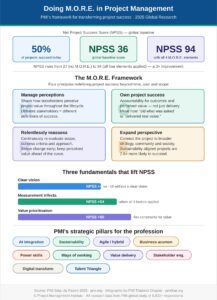
PMI’s research also identifies three fundamental drivers that lift NPSS:
- Clear vision: Projects with a well-communicated vision of success score a NPSS of +41, compared to −18 without one
- Measurement: Applying all three aspects of measurement (defining success criteria, having a system in place, and tracking outcomes) yields a NPSS of +54
- Value prioritisation: Teams willing to flex project constraints to prioritise value achieve a NPSS of +60, versus +42 for those that do not
Critically, projects that measured sustainability and social impact were found to be 2.6 times more likely to achieve high success rates — and achieved an average NPSS of 47, compared to just 32 for those that did not.
What is the M.O.R.E. Framework?
Unveiled by PMI in 2025, M.O.R.E. is both a research-backed framework and a professional call to action. It acknowledges that the world has changed — projects are now engines of strategic transformation, not just delivery vehicles. And it challenges project professionals to expand their role accordingly.
M.O.R.E. stands for four guiding principles:
M — Manage Perceptions
A project can be perfectly executed and still be viewed as a failure if stakeholders do not perceive it as valuable. Managing perceptions means actively shaping how stakeholders understand and experience the project’s value throughout its entire lifecycle — not just at the end.
This involves transparent communication, regular stakeholder engagement, and recognising that different stakeholders define success in different ways. The project professional’s job is to bridge that understanding — proactively, not reactively.
O — Own Project Success
This principle challenges project professionals to move beyond the mindset of “I delivered what was asked.” Owning success means taking accountability for the full breadth of the project — its outcomes, its perceived value, and its real-world impact.
It is the shift from “project management success” (delivered on time and on budget) to “project success” (delivered meaningful value). As PMI’s research confirms, stakeholders and executives already expect this level of ownership: the majority of senior leaders expect project professionals to take primary responsibility for the elements embodied by M.O.R.E.
R — Relentlessly Reassess Project Parameters
In a world of constant change, static project plans are a liability. Relentlessly reassessing means continuously re-evaluating whether the project’s parameters — scope, approach, success criteria — still reflect what stakeholders value most.
This is not about scope creep or indecision. It is about staying calibrated to reality. Organisations that change priorities, adopt new technologies, or face market disruptions mid-project need their project professionals to sense those shifts early and adjust accordingly, keeping perceived value ahead of the curve.
E — Expand Perspective
Perhaps the most forward-looking principle, this calls on project professionals to zoom out — beyond the deliverable, beyond the team, and beyond the organisation. It means considering how the project fits within the broader business strategy, the community, and ultimately society and the planet.
This is not abstract idealism. PMI’s data demonstrates concretely that projects aligned to sustainability and societal goals outperform those that are not. Expanding perspective is how projects create lasting value — elevating our world, in PMI’s words.
The M.O.R.E. Impact: Why Only 7% Are Doing It — and Why That Must Change
PMI’s research reveals a troubling gap: only 7% of project professionals are currently applying all four M.O.R.E. elements holistically. Yet this small group is achieving dramatically better outcomes, with NPSS scores approaching 94.
This is not a knowledge problem. Most professionals understand these principles intuitively. It is a behaviour problem — a gap between knowing and consistently doing. PMI’s 2025 Pulse of the Profession report reinforces this: only 18% of project professionals demonstrate high business acumen proficiency — yet those who do achieve 27% lower failure rates and significantly better goal achievement compared to their peers.
The opportunity is clear. If Thai project professionals and their organisations can embed M.O.R.E. into daily practice, the return on that investment — measured in outcomes, stakeholder trust, and organisational value — would be transformative.
The Broader Context: PMI’s Strategic Pillars for the Profession
M.O.R.E. does not exist in isolation. It is part of a broader evolution of the project management profession that PMI is actively leading through research, standards, and learning pathways. Several strategic pillars are shaping the future of the profession — all of which connect directly to the M.O.R.E. mindset.
1. Artificial Intelligence (AI)
AI is no longer a future trend — it is a present reality reshaping how projects are planned, executed, and monitored. PMI has made AI a central theme in its research and learning agenda, including its landmark report Sustainability in the Age of AI: The Integration Imperative.
AI integration is also now embedded in the updated PMP® exam content, launching in July 2026. Rather than treating AI as a standalone topic, PMI integrates it across project planning, execution, and monitoring — reflecting the reality that AI-assisted decision-making is becoming standard practice.
2. Sustainability
Sustainability is no longer a compliance requirement or a “nice to have.” It is a strategic differentiator and a direct driver of project success. PMI’s data shows projects aligned to sustainability and ESG goals are 2.6 times more likely to achieve high success rates.
The updated PMBOK® Guide 8th Edition (published November 2025) makes sustainability one of its six core principles: “Integrate sustainability — consider environmental, economic, and social impacts when planning and delivering projects.” The 2026 PMP exam will test sustainability as a core competency.
3. Agile and Hybrid Approaches
The profession has moved firmly beyond the debate of “waterfall vs agile.” Today, hybrid approaches that blend predictive and adaptive methods have grown by 57% in recent years and are now the dominant delivery model. The updated PMP exam reflects this shift: adaptive and agile approaches will account for approximately 60% of exam content from July 2026, up from 50%.
PMI’s PMI-ACP® certification and its Agile Practice Guide continue to provide frameworks for professionals navigating this landscape.
4. Business Acumen
PMI’s Pulse of the Profession 2025 identified business acumen as the critical differentiator separating tactical project managers from strategic value creators. Professionals with high business acumen understand the macro and micro influences on their organisation, connect project decisions to financial and strategic outcomes, and are better equipped to manage perceptions and own success — core M.O.R.E. behaviours.
Business acumen is one of the three pillars of the PMI Talent Triangle, alongside Power Skills and Ways of Working.
5. Power Skills
Formerly called “soft skills,” PMI deliberately rebranded these as Power Skills to reflect their critical importance. Communication, collaborative leadership, innovative mindset, and empathy are the accelerators of high-performing teams. Organisations that prioritise power skill development achieve a 72% success rate in meeting business goals, compared to 65% for those that do not.
6. Ways of Working
The third pillar of the Talent Triangle, Ways of Working encompasses the full spectrum of delivery approaches — predictive, agile, hybrid, and design thinking. PMI encourages professionals to master multiple methods and apply the most effective one for each unique project context.
7. Value Delivery
Across all of PMI’s research and standards, value delivery has emerged as the overarching measure of project success. The PMBOK® Guide 8th Edition explicitly states: “Measure success by outcomes that matter to stakeholders, not by tasks completed.” This philosophy underpins M.O.R.E., NPSS, and the updated PMP exam alike.
8. Digital Transformation and Technology
Projects are the primary vehicle through which organisations pursue digital transformation — and the stakes are high. Research from McKinsey finds that 70% of digital transformation projects fail to meet their goals. PMI’s focus on upskilling professionals in digital tools, data literacy, and technology integration is a direct response to this challenge.
9. Stakeholder Engagement
The updated PMP exam merges communication and stakeholder management into a single, elevated domain — recognising that stakeholder engagement is not a process to follow but a capability to master. Managing perceptions (the “M” in M.O.R.E.) is impossible without deep stakeholder engagement competence.
10. PMI Talent Triangle — An Integrated Model
These pillars are unified through the PMI Talent Triangle, PMI’s framework for the combination of skills that organisations value most. Updated in 2021, the Triangle’s three sides — Ways of Working, Power Skills, and Business Acumen — directly map to the behaviours required to deliver M.O.R.E. PMI has explicitly stated that M.O.R.E. is embedded in the Talent Triangle as its foundational expression.
What M.O.R.E. Means for Project Professionals in Thailand
Thailand’s project economy is growing rapidly. From large-scale infrastructure investments and government digital transformation programmes to private sector innovation and the expanding startup ecosystem, project professionals are at the centre of some of the most consequential work in the country.
The M.O.R.E. framework offers Thai professionals and organisations a clear, evidence-based pathway to improve outcomes. It asks us to:
- Communicate value, not just status — manage how stakeholders perceive the project throughout its lifecycle
- Take ownership of outcomes, not just deliverables — hold ourselves accountable for whether the investment was worth it
- Stay adaptive — continuously reassess whether what we are building still reflects what stakeholders need
- Think bigger — connect project work to organisational strategy, community impact, and sustainability
These are not abstract ideals. They are practical behaviours, supported by data, that raise NPSS scores from 27 to 94.
How to Get Started with M.O.R.E.
PMI has embedded M.O.R.E. across its learning ecosystem. Here are concrete steps to begin:
- Read the research: Download the Step Up: Redefining the Path to Project Success with M.O.R.E. report
- Take the course: PMI’s PMI Essentials M.O.R.E. Maximizing Project Success e-learning course is free for PMI members
- Explore PMI’s Pulse of the Profession 2025: The Boosting Business Acumen report provides the latest data on what separates high performers from the rest
- Engage with PMI Thailand Chapter: Join our workshops, events, and chapter discussions where M.O.R.E. is being brought to life in the Thai project community
Conclusion: It Is Time to Step Up
PMI President & CEO Pierre Le Manh put it simply at the 2025 PMI Global Summit: we have the opportunity to do much better. The data, the frameworks, and the learning pathways are all in place. What remains is the collective decision of our profession to act.
M.O.R.E. is not a checklist. It is a mindset — one that asks every project professional to see themselves not just as a manager of tasks, but as a creator of value, a steward of trust, and an agent of change.
For PMI Thailand Chapter, this is both a professional obligation and an exciting opportunity. Thailand’s transformation requires projects that succeed — not in the narrow sense of ticking boxes, but in the fullest sense of delivering outcomes that genuinely elevate organisations, communities, and lives.
Let us commit to doing M.O.R.E. — together.
Resources & Further Reading
- Step Up: Redefining the Path to Project Success with M.O.R.E. (PMI, 2025)
- Maximizing Project Success Report (PMI)
- Pulse of the Profession 2025: Boosting Business Acumen (PMI)
- Sustainability in the Age of AI: The Integration Imperative (PMI, 2025)
- The PMI Talent Triangle (PMI)
- The New PMP® Exam — July 2026 (PMI)
- Delivering M.O.R.E. — PMI Learning Hub
PMI Thailand Chapter is the local community of the Project Management Institute, serving project management professionals across Thailand. Visit us at pmithai.org to learn more about our events, certifications, and community initiatives.