
The construction sector represents a significant environmental concern, accounting for over 35% of Europe’s waste and up to 12% of national greenhouse gas emissions. While the construction sector’s environmental impact is substantial, other industries must also prioritize waste reduction and carbon emission mitigation. The Circular Economy (CE) paradigm is crucial for aligning with global sustainability goals, which emphasize improving resource efficiency and reducing waste through reuse and recycling. In practice, Project Managers play a vital role in mitigating these environmental consequences by leveraging awareness, policy frameworks, and procurement strategies to encourage CE implementation. For existing buildings, prioritizing material reuse, refurbishment, and recycling is particularly vital. This approach substantially reduces the demand for new resources and significantly mitigates construction’s environmental footprint. Effective strategies include adaptive reuse, deconstruction (rather than demolition), and designing buildings for easy material recovery.
This presentation will share the findings from case studies and expert interviews conducted as part of this study, offering insights into Circular Economy implementation and promoting more sustainable construction practices.
Agenda:
-
Circular Economy Implementation
1.1 Construction waste
1.2 Circular Economy principle
1.3 Project Manager Roles for Circular Economy Implementation -
Case Study and Interview
2.1 Case study – Precast concrete factory
2.2 Interview
2.3 Perspectives on Circular Economy -
Circular Economy Implementation
3.1 Circular Economy Implementation in Thailand
3.2 Drivers and Barriers for Implementation
3.3 Recommendation
WORAWAT SRIUDOM is a CEO, Adjunct Lecturer, and Researcher with over 20 years of experience in Thai design 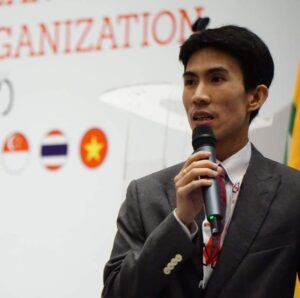 and construction. His extensive background includes holding key roles at a leading Thai contractor and serving as a consultant for a major mixed-use project development before founding his own firm. His core expertise spans feasibility studies, construction project planning and execution, precast concrete production, and steel fabrication.
As a Research Assistant, Worawat has collaborated with universities in the UK, US, and Denmark, primarily conducting research in construction management, green construction, and material application. He has also served as an Adjunct Lecturer at public universities in Bangkok for over six years. Holding both Bachelor’s and Master’s degrees in Civil Engineering, Worawat is currently pursuing a doctoral degree focused on Circular Economy construction. He is also a PMP certification candidate and a nominee for the Engineering Institute of Thailand (EIT) committee.
Circular Economy Perspectives in the Thai Construction Industry
Please register for the meeting prior to attendance. This helps us cater better to your needs.
Date: Thursday, July 17, 2025
Time: 18:15 – 20:30
Fees: 600 THB for members; 800 THB for non-members
Location: Four Points by Sheraton Hotel (previously known as Novotel Bangkok Ploenchit Hotel)
PDUs: 2 PDUs (1 Business Acumen, 1 Ways of Working)
Registration for this event is closed by 10 AM
This event qualifies for 2 PDUs (1 Business Acumen and 1 Ways of Working). If you are a PMI Thailand Chapter member, these PDUs will be registered for you by the Chapter. If you are not a member, you will have to submit these PDUs yourself. For more information on how to submit PDUs, follow this guideline.
EVENT INFO :
- Speaker:Worawat Sriudom
- Start Date:July 17, 2025
- Start Time:6:00pm
- End Date:July 17, 2025
- End Time:8:30pm
- Location:Four Points by Sheraton 566 Ploenchit Road Lumpini, Bangkok 10330, Thailand
- Website:pmithai.org
- Organizer:PMI Thailand